Showing posts with label Fear. Show all posts

Sunday, March 27, 2022

Take Away -SOM Part 19

I am still processing the Sermon on the Mount. I have gone through the 25 posts and edited them for clarity and to revisit them for myself. Now I want to look at the applications I should be making for myself.

SOM - Part 19

A man driving in heavy traffic gets pulled over for speeding. He says to the officer, "A lot of others were doing the same thing. Why am I the one who got pulled over?" The officer replies, "Have you ever been fishing?" To which the man nods his head yes, wondering where this is going. The officer then says, "Did you catch all the fish?"

Why do we think the guilt of others makes us less guilty? Because it doesn't. But it does at least somewhat explain why we are so quick to judge others, because it makes us look better. Sure, maybe I cuss, but at least I don't get drunk. Well, maybe I get drunk, but at least I don't do drugs. Sure, maybe I do drugs, but at least I don't beat my wife... I could go on, even to the point of circling back around to some of the same issues again, because the issues of others always seem to be worse that my own issues. 

Take Away: If, as I have stated, the main idea of the Sermon on the Mount is to return us to having a relationship with God instead of trying to be obedient to a level of law, then this section fits in perfectly. It is not that there may be times that I have to make judgments about the behavior of others, it's that I can't use those instances as a justification for my own sins. That is why I first have to remove the log in my own eye. You know, that big, fat piece of wood that is hindering me from seeing what I really need to see. If I really want to help my brother with his issues, I first have to deal with my own. Yet it is not just relationship with my brother that is impacted by this frame of mind, it is also relationship with God. The deepest relationships are also the most honest ones. Lack of honesty leads to lack of trust. Lack of trust leads to a deterioration of relationship.


Sunday, January 23, 2022

Sermon on the Mount - Part 18

 Today I want to look at verses 25-34 of chapter 6, once again focusing on who Jesus was speaking to, and on the context of the entire message.

Matthew 6:25-34

(25)“Therefore I tell you, do not be anxious about your life, what you will eat or what you will drink, nor about your body, what you will put on. Is not life more than food, and the body more than clothing? (26) Look at the birds of the air: they neither sow nor reap nor gather into barns, and yet your heavenly Father feeds them. Are you not of more value than they?  (27)And which of you by being anxious can add a single hour to his span of life?  (28)And why are you anxious about clothing? Consider the lilies of the field, how they grow: they neither toil nor spin,  (29)yet I tell you, even Solomon in all his glory was not arrayed like one of these.  (30)But if God so clothes the grass of the field, which today is alive and tomorrow is thrown into the oven, will he not much more clothe you, O you of little faith?  (31)Therefore do not be anxious, saying, ‘What shall we eat?’ or ‘What shall we drink?’ or ‘What shall we wear?’  (32)For the Gentiles seek after all these things, and your heavenly Father knows that you need them all.  (33)But seek first the kingdom of God and his righteousness, and all these things will be added to you."

 (34)“Therefore do not be anxious about tomorrow, for tomorrow will be anxious for itself. Sufficient for the day is its own trouble.

I know people who suffer from anxiety and other issues, so this is a tough one. I know it is difficult for some to just deal with the idea of being able to just cast your anxieties away. Sometimes these feelings have been put in place by some very real, very traumatic events, and our brains are created to adapt to such circumstances and certain defenses come in to play that change the way that we deal with even simple events. I don't think that Jesus is speaking to these people in the sense that they can just stop these feelings on their own with little to no effort, but rather He is setting forth principles for dealing with God. The principle that He seems to be alluding to here is that of faith and trust. Do we really believe that God is in control, and that He cares for us? If so, we will travel our life journey in a much more relaxed manner. It's like being on an airplane. If we trust the pilot, mechanics, designers, builders, etc., we will have a much more pleasant flight than if we worry about each person who is responsible for the safety of that flight. Did I mention the flight controllers? Are you worried yet? 

It is a matter of priority. Seek the kingdom first, then deal about the rest. There is so much that we do not have control of. Worrying about sickness, such as cancer, will not keep it from happening although I have heard of studies that suggest that worry does make us more prone to health issues. So in a sense, while worrying might not prevent something from happening, it might actually help it happen.

I recently read a quote, not sure of the exact phrasing, but here is the idea. "Tomorrow it will snow. You can take joy in the snow or not, but either way, you still have just as much snow." I think this is a great approach to life. Seek the kingdom first, take joy in God and His grace and mercy. Paul says it this way,  "Not that I am speaking of being in need, for I have learned in whatever situation I am to be content.  I know how to be brought low, and I know how to abound. In any and every circumstance, I have learned the secret of facing plenty and hunger, abundance and need.  I can do all things through him who strengthens me." (Philippians 4:11-13) Does that not sound like the words of a man who was first seeking the kingdom?

A note about Philippians 4:13. Notice that when Paul says these words, he is looking back, and stating how he was able to deal with the events, positive and negative, in his life. Perhaps another way of stating this could be, "I was able to endure all things because my faith in Christ gave me the strength to do it." This is not a forward looking promise that you will accomplish any endeavor you try because Jesus has got your back. But it is forward looking in the sense that whatever may come, your faith in Christ will help you endure it. 

Edited 2/11/2022

Monday, August 10, 2020

1 Thess 1:8-10

SCRIPTURE

For not only has the word of the Lord sounded forth from you in Macedonia and Achaia, but your faith in God has gone forth everywhere, so that we need not say anything. For they themselves report concerning us the kind of reception we had among you, and how you turned to God from idols to serve the living and true God, and to wait for his Son from heaven, whom he raised from the dead, Jesus who delivers us from the wrath to come.

COMMENT

Would Paul, or anyone else for that matter, say that about me? That my faith was so evident, others need not say a word? That is repentance. That is turning from self toward Jesus. They had worshiped idols, so had I. Different ones, but idols none the less. But do I serve God? Is it obvious? Or am I just fooling myself? I ask myself that a lot. Still haven't come up with a good answer. All I can do is fall on His grace.

Saturday, August 8, 2020

What Is Your Opinion? - 1 Thess 1:4-7

SCRIPTURE

1 Thess 1:4-7
For we know, brothers loved by God, that he has chosen you, because our gospel came to you not only in word, but also in power and in the Holy Spirit and with full conviction. You know what kind of men we proved to be among you for your sake. And you became imitators of us and of the Lord, for you received the word in much affliction, with the joy of the Holy Spirit, so that you became an example to all the believers in Macedonia and in Achaia.

COMMENT

Here we go again, so I will ask you, how do you understand the statement that God (he) has chosen you? If that is true, does it mean we have no role in the decision? Does God choose but we get to decide? If God chooses some to salvation, what about those not chosen by God? Are they without hope, or do they get to decide on their own. I know what I want to believe. I want to believe that all are capable of being saved. But what if I don't get what I want? Am I still willing to worship that God? These are tough questions, but questions that should be thought about if we are going to approach Scripture with the idea that maybe we are not the ultimate authority when it comes to how God should do things. So I pose questions without giving answers or opinions sometimes, because it is not what I think that matters, it is getting others to think.

It says that they received the word in much affliction. What??? No padded pews, pop music bands, funny preachers? How does that even work? (Heavy sarcastic tone should be noted.) In the midst of affliction, they were filled with joy. I wonder if that is why so many today seem so joyless? Perhaps where there is no affliction, the invitation to become a Christian is often not that Christ is the answer, it is that Christ will keep you from future affliction. Jesus is the vaccine shot that will keep you Corona free, and the cure for the common cold, and everything else for that matter. Maybe we need to read more Scripture.

Monday, June 29, 2020

Zeal is Not Enough! (Romans 10:1-4)

SCRIPTURE

Romans 10:1-4
Brothers, my heart's desire and prayer to God for them is that they may be saved. For I bear them witness that they have a zeal for God, but not according to knowledge (recognition, full discernment, acknowledgement). For, being ignorant of the righteousness of God, and seeking to establish their own, they did not submit to God's righteousness. For Christ is the end of the law for righteousness to everyone who believes.

COMMENT

Paul's heart is for Israel, and he desires that all Israel to be saved. He knows that they have a zeal for God, but he also knows that zeal is not enough. Is that not a frightening statement? But their zeal was misplaced, it was not based on a knowledge of God. He's not talking about some secret, gnostic heresy, he's talking about the truth one finds when God opens their heart to reveal Himself to them. Their zeal was based on what they could earn from God through obedience to the law. Paul has just spent the previous chapters trying to explain that salvation is not through obedience, but through faith. They, Israel, had sought righteousness through obedience, which makes it their own righteousness. God's righteousness comes through Christ, and the byproduct of that faith leads to obedience. There is such a huge difference in God's eyes.

Much like Paul, I think about the church, and how I wish that all could be saved. But my fear is that many in the church have the same issue as the Israelites, that they have a zeal, but not according to knowledge. They may have a different set of laws, but they still are trying to establish their own righteousness rather than submit to God's righteousness.

For some, perhaps the zeal is a result of wanting to be saved rather than wanting to be with God. But salvation is so much more than just not wanting to go to hell.

Christ is the end of the law. He is the end of trying to please God through our own efforts.  The result of trying to establish our own righteousness is anxiety, fear, mistrust, manipulation. Jesus said His yoke is easy, and His burden is light. (Matthew 11:30) Relax, trust, then obedience is a natural result, then the relationship will be a genuine relationship.

Wednesday, June 3, 2020

Fruit of the Spirit (Galatians 5:16-26)

SCRIPTURE

Galatians 5:16-26
But I say, walk by the Spirit, and you will not gratify the desires of the flesh. For the desires of the flesh are against the Spirit, and the desires of the Spirit are against the flesh, for these are opposed to each other, to keep you from doing the things you want to do. But if you are led by the Spirit, you are not under the law. Now the works of the flesh are evident: sexual immorality, impurity, sensuality, idolatry, sorcery, enmity, strife, jealousy, fits of anger, rivalries, dissensions, divisions, envy, drunkenness, orgies, and things like these. I warn you, as I warned you before, that those who do such things will not inherit the kingdom of God. But the fruit of the Spirit is love, joy, peace, patience, kindness, goodness, faithfulness, gentleness, self-control; against such things there is no law. And those who belong to Christ Jesus have crucified the flesh with its passions and desires.
If we live by the Spirit, let us also keep in step with the Spirit. Let us not become conceited, provoking one another, envying one another.


COMMENT

Everything Paul has been saying in Galatians is the precursor to these verses. Paul has been fighting the idea of those who wanted to put some kind of conditions on salvation in addition faith in Christ. I believe their problem was fear. Fear that telling someone that faith alone is all it takes would lead to some form of licentiousness. Paul answers that fear in verse 16. If we walk in the Spirit, we will not gratify the flesh. Those who walk this way are not under the law. Want to know if you are walking in the Spirit, it should be obvious, but Paul gives some examples of living by the flesh. He then goes on to show what it should look like if we are living by the Spirit. In all of this, Paul does not feel the need to give a list of rules.

Truth is, there will be those who will take advantage of the gospel, who will here only what they want to. Paul knew this could not be avoided. So do I. You will always have your Osteens and Battersons etc. who prey in one form or another on others. Who prey on those who want to hear a particular message because of their own bias or desires. Those whose ears are itching for salvation, but not in the form of the gospel. Their condemnation is still deserved. Those are difficult words to speak and to hear, but I believe that that is exactly what Paul is saying in Galatians. Guard your privy parts!

Thursday, May 14, 2020

Are You Sure? (Galatians 1:6-10)

SCRIPTURE

Galatians 1:6-10
I am astonished that you are so quickly deserting him who called you in the grace of Christ and are turning to a different gospel— not that there is another one, but there are some who trouble you and want to distort the gospel of Christ. But even if we or an angel from heaven should preach to you a gospel contrary to the one we preached to you, let him be accursed. As we have said before, so now I say again: If anyone is preaching to you a gospel contrary to the one you received, let him be accursed.For am I now seeking the approval of man, or of God? Or am I trying to please man? If I were still trying to please man, I would not be a servant of Christ.

DEFINITION

Vs 7 Trouble - ταράσσω tarassō: to stir or agitate (roil water): — trouble.
to agitate, trouble (a thing, by the movement of its parts to and fro)to cause one inward commotion, take away his calmness of mind, to disquiet, make restless, to stir up, to trouble, to strike one's spirit with fear and dread, to render anxious or distressed, to perplex the mind of one by suggesting scruples or doubts

Vs 9 Accursed - ἀνάθεμα anathema: a (religious) ban or (concretely) excommunicated (thing or person)
a thing set up or laid by in order to be kept specifically, an offering resulting from a vow, which after being consecrated to a god was hung upon the walls or columns of the temple, or put in some other conspicuous place, a thing devoted to God without hope of being redeemed, and if an animal, to be slain; therefore a person or thing doomed to destruction, a curse, a man accursed, devoted to the direst of woes

COMMENT

One of the thoughts that has often occurred to me is this, If only 20 to 40 years after the death of Christ, there were already those who were needing to be corrected in their doctrine, why is it that so many people, with so many different thoughts, all think they are correct over 2,000 years later?

Paul starts this section by stating that those who have turned to this different gospel have deserted Christ. That is a powerful statement. As I understand what Paul is addressing here, it is the thought that in addition to the sacrifice that Jesus gave on our behalf, obedience to certain laws was also necessary. (1:15-21, so more on that later.) To hold to such a belief is to believe that the sacrifice of Christ alone was not sufficient for salvation. I believe that this, at least in part, preys upon the the feeling that there must be something we have to do in order to deserve salvation. It is hard to believe that God would freely give such a wonderful gift.  Paul says that those who think this way have deserted Christ. He goes on to give a reason why these men would teach such a thing: to trouble us and to distort the gospel. Let's take a look at the word trouble, because it carries a lot of meaning here. The word means "to stir or agitate. The picture given is calm water that is disturbed such as by throwing a rock in it. That rock removes the calmness of the entire body of water. It agitates it. Think about our spirit when it gets agitated. It fears, it gets short, it can cause doubt and a number of other issues. This goal is accomplished when we give in to the idea that in addition to what Jesus has done to save us, we also must do something to save our soul. That in addition to our faith, we must (fill in the blank with any number of things that could apply, not limited to drinking alcohol, Bible study, prayer, communion, baptism, cursing, etc. etc. etc.)

He then ups the consequence even more by saying that if anyone, including himself or even an angel, should preach a gospel contrary to the one they first received, they should be accursed. This word carries with it some dire meaning: Excommunication, no hope of redemption. So this is not just Paul acting like a witch, throwing out a spell on an individual, it is Paul saying that a person such as this stands condemned before God! Let me state that more clearly: If someone requires external obedience as a requirement for salvation other than faith, they stand condemned.

Paul knew that these words would be offensive, and he did not care! (Think Ricky Gervaise at the last Golden Globes.) He could not care, for if he did he would not be preaching the truth and would himself be in danger of damnation. Verse 10 shows that he is not saying this with the goal of seeking to please men, for if that were his goal, he would not be a servant of Christ.

Watch the video below. Then look at the questions and comments that follow.


  • She "grew up in the church," and believes that the people in the audience are getting frustrated with the speaker. But shouldn't this be the case? Doesn't 1 Cor 1:23 tell us that Christ crucified is a stumbling block? Phil 3:18, that many walk as enemies of the cross? Should the level of audience frustration determine our message?
  • She states that "You're not portraying the kind of God that people need." Which is to say, it is not about God, but it is about a god that will be acceptable to these people, a god whom they will embrace because it satisfies them, and not because He is the holy God of the universe. Is she asking the preacher to tell them what they want to hear to gain their acceptance? (see 1 Timothy 4:3)
  • She states that she thinks the speaker and her believe the same thing, but I don't think so. Do you?
  • She states that she evangelizes the way that Jesus did it. But I wonder if this is not a matter of her own perception or desire rather than a matter of truth. If all Jesus ever did was live a good life and try not to offend people, why did they crucify him? 
  • In response to his comment that we are commanded to preach the gospel, she adds, "And live it." Is this true? And if so, what does it look like? In light of what is taught in Galatians, is this not an addition to the gospel? 
  • She wants to make his his conversion rate an issue. Should it be? (See 1 Cor 3:7,8)
  • She states that "This doesn't make people want to accept the gospel." If this is correct, and I would agree that it often is, can we change the message in order to get people to accept it? If we do, what are some of the consequences?
This woman is sincere. So are a lot of other people. I appreciate her sincerity and passion. But is she right, is she dealing in truth? Emotions do not determine right. If they did, we wouldn't need Scripture, would we?

Monday, May 11, 2020

When Confusion Reigns (Matthew 26:47-56)

SCRIPTURE

Matthew 26:47-56

COMMENT

The disciples thought they knew what was going on. They had seemingly resigned themselves to going with Jesus, even if it meant death. All except for Judas, of course. So after falling asleep while Jesus prayed, Jesus comes to wake them, telling them he is about to be betrayed. Enter Judas and a crowd with clubs and swords. Judas approaches Jesus and kisses him, a sign to the others who is the one they are after. They approach and seize Jesus. Here is where it gets awkward.

One of the men with Jesus pulls out a sword and cuts off the ear of the High Priest's servant. The battle is on, and it is a fight to the death. But wait, for Jesus tells him to put the sword away. What!?! Not only that, but according to Luke's version, he even healed the man's ear. How are you going to win a battle when Jesus keeps healing the enemy! How confused they must have been. So when the soldiers lead Jesus away, they flee.

Imagine the agonizing hours and then days of confusion that must have followed. We thought we were supposed to fight and even die with Him if necessary, but He stopped us and went willingly, talking about how this had to happen so that Scripture would be fulfilled.

Ever get confused like that? You think that God has one thing in mind in a situation, but it takes a whole different path. Does that mean that God is not in control? Of course not, it just means that our expectations were not in line with His. But that is hard to accept, because we were so sure of the path things would ultimately take. Reminds me of Garth Brooks song, "Unanswered Prayers."


I think it has a lot to do with expectations and faith. Not the prosperity gospel idea that God did not give us the answer we wanted because we did not have enough faith, but the idea that God is in control and we knows where He wants things to go. I recall a trip I made with my did many years ago. As we got in the car, I asked where we were going. He responded, "You'll find out when we get there." You know what? He was right.

Monday, May 4, 2020

Working for a Living (Matthew 25:14-30)

SCRIPTURE

Matthew 25:14-30

COMMENTS

Quick summary: Master gives 3 servants different amount of money to care for while he is gone. 2 double that money, one digs a hole and hides it there until the master returns. The first two are rewarded (with more responsibility), the third one is cast into outer darkness.

So what makes the difference? I think it would be too simple to say that the first two were rewarded based on the fact that the made a profit for the master. Is it profit the master was after? I don't think so, I think it was respect, or maybe appreciation. You see, the first 2 not only give the master what they were given, but they gave him what they had earned. They were proud of what they had done for their master. As a result, the master increases their responsibility. But the third servant saw things differently. He saw the master as a hard man. A man he felt was lazy and made his wealth off of the hard work of others. And here's the kicker, he was afraid of the master. Maybe he was afraid that if he failed or lost money, the master would have held him accountable, and made him pay back the full amount or more. So in his fear and anger and whatever else he may have been feeling, he took the money and buried it. At least that way, he would be able to give the master what was his.

We live in an age of perceived entitlement, were many think that someone having more than they have is unfair, no matter how they got more. Whole political campaigns are run with the idea of the wealthy sharing what they have with those who do not have as much. Not through charity, not through anything the poor have done, but just because they have more. In fact, those who have less are given no responsibility, other than to hold their hand out. Some realize that the wealthy are entitled to their wealth. Like the first two servants in the story, they appreciate the opportunity to serve their master. They give him the honor and respect he is due. But some feel entitled, like the third servant. Their response is a spit in the face to the master, taking the money and burying it. The words, "Here, you have what is yours." speak volumes about this man's contempt for the master.

And so it is with God. There are those who understand that God owes us nothing, and that we can serve him in any manner is a privilege. Then there are those who believe God owes us something. Not just in the realm of prosperity preachers, but also in the heart and attitude of many a believer. Prayers are nothing more than wish lists, the preaching that appeals tells us what God will do for us, and how He will make life easier and better. Compare that to the lives of the saints, and you will find a different story.

Tuesday, March 31, 2020

What Do I Lack? (Matthew 19:16-22)

SCRIPTURE

Matthew 19:16-22
And behold, a man came up to him, saying, “Teacher, what good deed must I do to have eternal life?” And he said to him, “Why do you ask me about what is good? There is only one who is good. If you would enter life, keep the commandments.” He said to him, “Which ones?” And Jesus said, “You shall not murder, You shall not commit adultery, You shall not steal, You shall not bear false witness, Honor your father and mother, and, You shall love your neighbor as yourself.” The young man said to him, “All these I have kept. What do I still lack?” Jesus said to him, “If you would be perfect, go, sell what you possess and give to the poor, and you will have treasure in heaven; and come, follow me.” When the young man heard this he went away sorrowful, for he had great possessions.

LANGUAGE

Vs 16  good deed - ἀγαθός agathos; a primary word; “good” (in any sense, often as noun): — benefit, good(-s, things), well. Good, good thing, that which is good, the thing which is good, well, benefit, of good constitution or nature; useful, salutary; good, pleasant, agreeable, joyful, happy; excellent, distinguished; upright, honourable

COMMENT

First, a comment about something I read in a commentary once. What if this unidentified young man in the story was someday to become the apostle Paul?  It does make for an interesting thought while trying to understand this story.

So many interesting details are embedded in this story, but I want to focus on what I see as the main idea. I see the main idea as Jesus teaching true repentance. I see that idea in a lot of what Jesus teaches, starting with the Sermon on the Mount. What we seem to have here is a young man who is "perfect" in his observance of the law, and yet perhaps sees that that still might not be enough to secure his place in heaven for eternity. He is correct, but Jesus, knowing his understanding of religion, needs to guide him to a different way of thinking. The question the man asks is, "What good thing must I do to have eternal life?" I presume his thinking is that their is some tangible act that he can perform that will tip the scales of balance assuredly in his favor. Wouldn't we all want that? But rather than give him a direct answer, Jesus focuses on the phrase, "good deed." Another way to think about this, and perhaps with better understanding of what the man was truly asking is, "What distinguished act can I perform that will set me apart in the eyes of God (and therefore others as well) that will assure my salvation?" Jesus needs to address this idea of "good." Since even our righteous acts are as filthy rags (Isaiah 64:6), Jesus makes it clear that only God is good in this sense. Then He goes on to say, "If you would enter life, keep the commandments."

What? Jesus advice here is to follow the law, to do the very thing this young man already believes? Understand, that Jesus is still trying to convince this man that this path is still a vain one. The man responds, asking Jesus, "Which ones?" Seems as though the young man understands the difficulty, if not the impossibility of keeping them all, so in effect he seems to be saying, "Which ones do I really have to keep, because no one could keep them all." So Jesus plays along, and gives him so to follow. Great, the man must be thinking, I am good here and have kept all these. But surely there is still something missing, so he asks his final question, "What do I still lack?" The answer Jesus gives is mind-blowing, not just for this man, but for about everyone who has heard it since. "If you would be perfect, go, sell what you possess and give to the poor, and you will have treasure in heaven; and come, follow me." What? Everything? That's too much, I can't... and he walks away in sorrow, because he had a lot of possessions.

Where was Jesus leading this man? I believe that He was leading him to an understanding that the law was not enough. That no matter what this man did, he would not appear perfect before God. But since this is also recorded in Scripture, what is He saying to us? Must I sell the house and car, take out the retirement plans and distribute them to the poor? I have heard some say, "Well, you just have to be willing to do that." Really? And I suppose I just have to be willing to pick up my cross and carry it? I think that line of reasoning just seeks to do the very thing the young man in the story is trying to do, justify our behavior, justify a lack of true perfection and obedience.

The truth of the matter is that no one can meet this level of perfection. I believe this is the truth that Jesus is trying to convey here. Notice Jesus does not just say give it all away, He also says "come, follow me." That is where the needs get met. That is where perfection is given. That is what I believe is the true main idea of this story, repentance. Not just the turning away from sin, but the turning to Jesus. You can't give away everything and live. For is you follow that logic to the extreme, you could not ever eat or even drink again. For if someone gave you some food or drink, you would be obligated to give that to someone else before meeting your own needs. But in repentance, we turn from what we have and depend on Jesus to provide. Maybe then we sell that house, or at least downsize so that others may be taken care of too. Or we trade for a cheaper car, or eat Ramen noodles instead of caviar and lobster. We take on a mind that is transformed, and it is no longer about us, it is about Jesus. In other words, we repent.

Saturday, March 21, 2020

40,000+ People Can't Be Wrong, Right? (Matthew 16:24-28)

SCRIPTURE

Matthew 16:24-28
Then Jesus told his disciples, “If anyone would come after me, let him deny himself and take up his cross and follow me. For whoever would save his life will lose it, but whoever loses his life for my sake will find it. For what will it profit a man if he gains the whole world and forfeits his soul? Or what shall a man give in return for his soul? For the Son of Man is going to come with his angels in the glory of his Father, and then he will repay each person according to what he has done. Truly, I say to you, there are some standing here who will not taste death until they see the Son of Man coming in his kingdom.”

LANGUAGE

Vs 24  come - accompany
Vs 24  after - follow
Vs 25  save - protect
Vs 25  lose - destroy
Vs 25  find - find, get, obtain, perceive, see

BACKGROUND

Jesus had just foretold His death to the disciples. Peter rebukes Him, because Peter is thinking the way a man thinks. But Jesus rebukes Peter for not setting his mind on the things of God.

COMMENT

Jesus is continuing His thoughts after rebuking Peter for telling Him that He should not have to die. I think Peter might have easily be taken in by someone like Joel Osteen and his "Your Best Life Now" philosophy. But now Jesus is speaking to everyone, and it is not about your best life now. In fact, it is just the opposite. This is a hard truth. But if we interpret this teaching in light of the idea that repentance is the change of life one experiences after really understanding and knowing Jesus, and not just a matter of wanting to get to heaven or avoid hell, then it makes perfect sense.

To save or protect your life is to destroy it. Again, in light of the Corona Virus, I cannot help but think of people who are putting their own survival (or just even comfort) in front of everyone else. I just watched a video from Germany where a woman was struggling to carry more toilet paper than she was probably able, while others in the background were also stock piling supplies. How are some of these people going to live with themselves when this is over? And in their effort to protect themselves, are they not already losing some of themselves in the process? But we do tend to live in the moment, don't we?

I keep thinking of Jesus's teaching about the narrow road. I also think about how many people think they are on that road. People who believe that God owes them something, that they can get on God's good side by flashing their sacrifice (which Isaiah calls "filthy rags) before Him. All that travel just to get to a road whose end is not their desired destination. Wake up, people.

Wednesday, January 22, 2020

Anxiety and Frustration

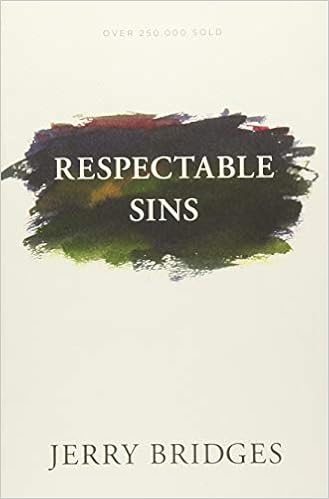
I am currently reading the book, Respectable Sins by Jerry Bridges.

Not sure I agree with the labeling of anxiety and frustration as sin, but maybe that is due to a lack of understanding on my part. (Chapter 8)

I feel anxiety, frustration, fear, happiness, sadness, and many other emotions at times. I don't believe I am in control of the initial feelings, but what I am in control of is the response to those feelings. " Be angry and do not sin; do not let the sun go down on your anger." (Eph. 4:26 ESV) It is not anger that is sin, but how I handle it. Emotions, in my opinion, are a gift from God. Does not fear protect us? Is not the beginning of wisdom fear? I believe it is good for us to recognize and identify our feelings, and to not let our emotions get the best of us. 

Bridges asks toward the end of the chapter, Can you picture Jesus ever being anxious or frustrated? My answer is yes, I think so. What about in the temple with the selling of animals for sacrifice? What about in the garden when he was in agony and his sweat became like great drops of blood falling down on the ground? I believe that the sin is not in the emotion itself, but rather can be found in inappropriate reaction to those emotions. I think we would both agree that our response to feelings and emotions always needs to focus on God rather than ourselves.