SCRIPTURE
Matthew 7:12-14
"So whatever you wish that others would do to you, do also to them, for this is the Law and the Prophets.
"Enter by the narrow gate. For the gate is wide and the way is easy that leads to destruction, and those who enter by it are many. For the gate is narrow and the way is hard that leads to life, and those who find it are few."
LANGUAGE
Vs 12 Wish θέλω thelō; to determine, choose or prefer (literally or figuratively); by implication, to wish, i.e. be inclined to (sometimes adverbially, gladly); impersonally for the future tense, to be about to; by Hebraism, to delight in: — desire, be disposed (forward), intend, list, love, mean, please, have rather, (be) will (have, -ling, - ling(-ly)).
COMMENTS
This is so not us. I was walking out of the store today, and someone called out, "Sir!" I looked to see someone picking up some money. I immediately thought, "Do they think that is mine?" I even checked my pockets as if to see if there was money missing, but I had paid by credit card and had no cash in my pockets. Just wishful thinking. Turned out that the money belonged to the one picking it up, and another person thought I might have dropped it.
But there was that immediate reaction I had, was the money mine? Had I dropped some and did not even recognize it. It was only a few dollars, but would I have taken it if offered?
Do what you wish (desire) others would to do for you. The person who saw the money fall did that. Rather than try to pick it up, she got my attention before I walked out the door. Did she have a moment of temptation to grab it for herself? This is so not most people. But again, it speaks to the kind of person Jesus was talking about in the beginning of the Sermon on the Mount. The humble, righteousness loving, God pursuing person. Looking out for the good of others because I would hope that others are looking out for the good of me. Its a narrow road. Its a small percentage of people who actually get and live this. That is what Jesus is saying. The other gate, the gate that takes the money, that looks for its own good, that road is wide and easy. But the destination is not our destination.
If you want to get to your destination, you have to take the road that leads you there, and not necessarily the road that is the smoothest, prettiest, or widest.
SIDE NOTE
Ever see the Seinfeld episode where Kramer is taking care of a section of the highway? So one thing he does is to take the four lane road, and paint out some of the lines to make it a two lane road, where the lanes are wide and luxurious. Imagine the chaos when all of a sudden 4 lanes are down to 2. Maybe that is part of the danger of the wide road. Yes, there is more room, but you are sharing it with more people. And maybe some shady ones at that.
Showing posts with label Christless Christianity. Show all posts
Showing posts with label Christless Christianity. Show all posts
Friday, February 28, 2020

Monday, February 24, 2020
The Truth of the Matter
Yesterday our study in the books of John, by Dr. Tony Evans, concluded with the book of Third John. Evans spoke a lot about truth, which I find ironic, because he apparently denies the doctrine of original sin and also believe that Jesus is not the only way to God. At least, that is what the internet says, so it must be true.
Book of 3 John
Our leader asked a question during the lesson, "What is truth?" Answers were vague and the expected Sunday School answer to almost every question was given, "Jesus." Yes, Jesus is the truth, but I do not think that is what John is referring to. In fact, in verse 2 when John says, "I pray that all may go well with you and that you may be in good health, as it goes well with your soul," I am not sure that John is referring to physical health here. The word translated "well" here directly applies to health, but it also states that it figuratively applies to sound doctrine. Perhaps John is referring to both, but since he speaks so much about truth in this short letter, I tend to think the emphasis would be on the latter.
So what is truth? I believe John is referring to sound teaching, doctrine. I go back to the book of Galatians, where some came in who were teaching the necessity of circumcision. They too, like Diotrophes in 3 John, were strong men who apparently like to put themselves first. Paul has strong words for them, going as far as to say, "I with those who unsettle you would emasculate themselves." (Galatians 5:12) In Galatians, it is clear that Paul is battling a teaching that said that in addition to faith, certain requirements must be met. Perhaps John is combating a similar idea. Or maybe it is just that this person is stirring up dissension through other means. Whatever the case, truth is obviously important to John. And finding out and following the truth should be just as important to us. Getting into the word of God, and not just trusting others, even if those others seem important or righteous, does not remove the burden of our individual responsibility. With so many different opinions out there, it just makes sense to check things out for yourself.
Book of 3 John
Our leader asked a question during the lesson, "What is truth?" Answers were vague and the expected Sunday School answer to almost every question was given, "Jesus." Yes, Jesus is the truth, but I do not think that is what John is referring to. In fact, in verse 2 when John says, "I pray that all may go well with you and that you may be in good health, as it goes well with your soul," I am not sure that John is referring to physical health here. The word translated "well" here directly applies to health, but it also states that it figuratively applies to sound doctrine. Perhaps John is referring to both, but since he speaks so much about truth in this short letter, I tend to think the emphasis would be on the latter.
So what is truth? I believe John is referring to sound teaching, doctrine. I go back to the book of Galatians, where some came in who were teaching the necessity of circumcision. They too, like Diotrophes in 3 John, were strong men who apparently like to put themselves first. Paul has strong words for them, going as far as to say, "I with those who unsettle you would emasculate themselves." (Galatians 5:12) In Galatians, it is clear that Paul is battling a teaching that said that in addition to faith, certain requirements must be met. Perhaps John is combating a similar idea. Or maybe it is just that this person is stirring up dissension through other means. Whatever the case, truth is obviously important to John. And finding out and following the truth should be just as important to us. Getting into the word of God, and not just trusting others, even if those others seem important or righteous, does not remove the burden of our individual responsibility. With so many different opinions out there, it just makes sense to check things out for yourself.
Tuesday, January 21, 2020
Right verses Righteous
I am currently reading the book, Respectable Sins by Jerry Bridges.
 Thoughts after reading Chapter 7
Is it possible to do right, yet be unrighteous? I believe it is. There are many people who do not believe in Jesus who are what the world would call "good people." But just being good without recognizing our dependence on God is not righteousness, it is just doing right. Jesus did not die so that we would do right. In fact, one might say that to do right without depending on God is actually ungodliness.
We are not only to eat to the glory of God, we are to drive to the glory of God, we are to shop to the glory of God, and we are to engage in our social relationships to the glory of God. Everything we do is to be done to the glory of God. That is the mark of a godly person.
Bridges, Jerry. Respectable Sins (p. 51). NavPress. Kindle Edition.
I think of the parable of the wise and foolish builders. Two buildings (lives?) that looked the same (good deeds?) But one had no foundation, so it eventually crumbled. The other, with the rock for its foundation (godliness?) survived.
So then, righteousness is the overflow of a heart that is focused on God. Perfect righteousness? Don't fool yourself. But righteousness none the less. And a righteousness that is focused on God will be a righteousness that will grow (sanctification).
Is it possible to do right, yet be unrighteous? I believe it is. There are many people who do not believe in Jesus who are what the world would call "good people." But just being good without recognizing our dependence on God is not righteousness, it is just doing right. Jesus did not die so that we would do right. In fact, one might say that to do right without depending on God is actually ungodliness.
We are not only to eat to the glory of God, we are to drive to the glory of God, we are to shop to the glory of God, and we are to engage in our social relationships to the glory of God. Everything we do is to be done to the glory of God. That is the mark of a godly person.
Bridges, Jerry. Respectable Sins (p. 51). NavPress. Kindle Edition.
I think of the parable of the wise and foolish builders. Two buildings (lives?) that looked the same (good deeds?) But one had no foundation, so it eventually crumbled. The other, with the rock for its foundation (godliness?) survived.
So then, righteousness is the overflow of a heart that is focused on God. Perfect righteousness? Don't fool yourself. But righteousness none the less. And a righteousness that is focused on God will be a righteousness that will grow (sanctification).
Sunday, December 8, 2013
Flip a coin

Michael Horton. Christless Christianity: The Alternative Gospel of the American Church (p. 250). Kindle Edition.
"No one can come to me unless the Father who sent me draws him" (John 6, v. 44).
Michael Horton. Christless Christianity: The Alternative Gospel of the American Church (p. 259). Kindle Edition.
These Scriptures seem pretty specific. And to be honest, downright scary. Because as I understand them, they mean that salvation is out of my hands, and I don't like that. I guess I prefer the formulas, the guarantees.
But then there are those Scriptures which seem to say the opposite. Philippians 2:12 comes to mind. "Therefore, my beloved, as you have always obeyed, so now, not only as in my presence but much more in my absence, work out your own salvation with fear and trembling."
That sounds better, because now I am back in control.
But which is it? Am I in control or not? Perhaps I should just flip a coin. Or not.
Here is my take. Salvation completely depends on God. Not even 1% can be attributed to me, no works, no decision on my part, nothing. I know that many would disagree with me, and I am okay with that. I understand how hard it is to accept such thinking. And even for those who agree, there are many divergent paths from this point forward. Not time to discuss those now.
That being said, I don't know who God has chosen and who is not chosen. Therefore, since I am the instrument of God, I obey and carry the Gospel with obedience and great care. And one of the things that I must be careful of is not to get the big head, thinking more of myself than I ought just because God has chosen me. This is the God of the universe we speak of, and I am but a mist. I should never forget that.
Thursday, December 5, 2013
Why religion stinks
Michael Horton. Christless Christianity: The Alternative Gospel of the American Church (p. 243). Kindle Edition.
Makes sense, because I believe that the same could be said of the individual. Institutions, just like individuals, need humility. I think that is something that is incredibly lacking in the American church. But if you are a regular reader here, you already know that.
There is just something about nakedness that bothers most people. When we are naked, are flaws are exposed. Especially as I grow older, I have a tendency to buy looser fitting clothing. It is as if I think you won't notice my flaws because you can't tell the folds in my sweater from the folds in my flab.
So imagine standing "naked" before God. Not only are your flaws exposed, but they are exposed in the light of his perfection. That is why when we do stand before God, the only confidence that can possibly mean anything is our confidence in Christ alone. Alone. In Christ alone. Notice the clinginess. Like hiding behind the big kid in dodgeball, only better.
Which is why religion and morality ultimately stink.
Monday, December 2, 2013
The fate of the church
Michael Horton. Christless Christianity: The Alternative Gospel of the American Church (p. 233). Kindle Edition.
How wonderful to know that the fate of the church is in the hands of God, and not sorry sinners such as myself! I find so much peace in that thought.
Sunday, December 1, 2013
The butler didn't do it
Michael Horton. Christless Christianity: The Alternative Gospel of the American Church (p. 229). Kindle Edition.
Doesn't the Bible teach both? That we serve God (Romans 12:1-2) and that He serves us? I think the key word in the quote is "need." God does not "need" us to serve Him, but we do need Him to serve us.
Now that can be twisted. I am not talking about God serving me by fulfilling my every desire. Yet without the cross, without the sacrificial service of Christ, we are doomed. We need that. Without God's daily provision to keep our bodies functioning, the world spinning, the sun providing warmth and energy, we are gone. We need God, and it is this realization that both humbles and empowers us. At least it should.
Friday, November 29, 2013
Pass the butter?
Michael Horton. Christless Christianity: The Alternative Gospel of the American Church (p. 219). Kindle Edition.
I think when it comes to communion, I drift to the idea of works based religion more than any other time. Have I been good enough? Am I worthy to partake. The answer should always be, "No, not outside of the grace of Christ." So perhaps partaking in a worthy manner is not about me, at least in the sense of my behavior. But it is more about me and the question, "Am I willing to accept the gift that Christ is offering?" Am I willing to understand my own sinfulness and partake of the body and blood of Christ, fully understanding that without this sacrifice, I am damned. Those are strong words, but communion is a strong image. One that I believe is intended to evoke a great appreciation in the hearts of Christians.
Thursday, November 28, 2013
How can some be forgiven more?

Michael Horton. Christless Christianity: The Alternative Gospel of the American Church (p. 205). Kindle Edition.
Some might ask, are some forgiven more than others? No, I don't believe so. The context of this quote really goes to the perception of the one who is forgiven. If I think I am an okay guy, if I think I follow all or most of the moral obligations thrown my way, if I compare myself to others and see them as worse than me, then perhaps my level of the perception of my forgiveness is not all that high, and therefore my understanding of the depth of God's grace is not so high either. But if I see myself as a sinner saved by grace, no better or no worse than any other sinner, and I perceive the depth of God's love to me in the giving of His Son, then how can my reciprocation of the love not be great? Not because I want to prove my worth to God, but because I have seen my worth to Him.
Happy Thanksgiving!
Wednesday, November 27, 2013
What he said...

Michael Horton. Christless Christianity: The Alternative Gospel of the American Church (pp. 190-191). Kindle Edition.
Okay, I think this is a bit of a blanket statement. Not everyone who goes to a specific church believes this, but I think that there are many who even unknown to themselves have this type of belief system. And I think that many specific churches, perhaps unintentionally, promote this type of belief. The list of items in the quote are not bad things, they are just not the end itself. Christ is the end. And sometimes our programs promote this type of belief. We promote slogans like, "Be the Church." Yet instead of telling us what it means to really be the Bride of Christ, we promote specific behaviors. Perhaps what we really need is marriage counseling! We follow slogans like, "Be Jesus" instead of encouraging belief in Jesus. To be Jesus is a heavy burden I cannot bear, although perhaps I would like to think I could. Believing Jesus, on the other hand, gives me hope.
Tuesday, November 26, 2013
What's in your preaching?
Michael Horton. Christless Christianity: The Alternative Gospel of the American Church (p. 145). Kindle Edition.
I think back to most of the in-person preaching I have heard in the past 5 to 10 years. While my opinion of some of it was okay (at that time), I now look back and say to myself, "Where was I really challenged to grow?" or "What did I hear that was not something that most in the audience did not already agreed with?" or "Yeah, I remember reading that book too."
I still go back to inviting my heroine addicted brother to come to church with me, and him actually saying yes. Then, after the service, when I had heard what at the time I thought was powerful, I dared to ask what he thought. He replied, "I thought it was lame." It took me a while, but I think so too now. What we had heard was a rah-rah session for believers. No gospel, just a statement of we as Christians are right! Jesus is the answer for white, middle-class America. Sign-up now for your spot in heaven!
But now that I see that I am a sinner, that is not what I want to hear. I want absolution. I want to know that Christ offers that to me. I can go to the movies myself.
Monday, November 25, 2013
If at first you don't succeed...
Michael Horton. Christless Christianity: The Alternative Gospel of the American Church (p. 130). Kindle Edition.
Another interesting thought, one that has proven itself true in my experience. Now I know there are some who can excel just through their will. At least for a time. My brother is a great example. He kicked a heroine habit just by gutting it out. After being homeless, living on the streets, stealing just to get the next fix, he finally gave up and went home. When mom and dad picked him up at the airport, they barely recognized him. He went through the withdrawl phase and did not pick up a needle again...for about 10 years. They say heroine is the hardest drug to overcome, its addiction is so powerful. So ten years is an amazing feat. But once he picked it up again, he couldn't put it back down, no matter how much he wanted to. He went through the withdrawal phase time and again, but soon after was back for more. Finally, in utter despair, he took his life.
The world says keep trying. Or try harder. Jesus says something completely different. He tells us to come to Him. He says surrender. Those are difficult words for folks in our culture.
Saturday, November 23, 2013
Dad started doing the dishes
Michael Horton. Christless Christianity: The Alternative Gospel of the American Church (p. 124). Kindle Edition.
I find this to be an interesting quote. Doesn't living the gospel sound like a good idea? I hear people say things like "Be Jesus," and "What would Jesus do?" Aren't these things okay?
What does God really want from us? Many people would answer "relationship." But I think that depends on your definition of relationship. The Bible says God wants belief. But even that can be a tricky word to define. And then there are James' words that "even the demons believe - and shudder!"
So the belief that we have is not merely intellectual assent. It is a knowledge that leads to an action.
For some reason, I have been thinking about my Dad a lot lately. Growing up he was the bread winner, and Mom took care of the house. He got home from work at 5:00, and dinner was on the table as he stepped through the door. Afterwards, he did the man things that needed done around the house. Or sometimes took a nap on the couch. But after he retired, Dad was often found in the kitchen, cleaning up the dishes, even though Mom told him he didn't need to do it. (But I could tell that she really liked it.)
Why did he do it? Was it an attempt to get Mom to love him more? I don't think so. Was it guilt over all of the years she had done so much in the kitchen while he seldom set foot in there? Nah. I think it was just a deep expression of his appreciation and love for her. Over the years they had done so much for each other. I can still see Mom in the kitchen, making Dad an extra sandwich with the cheese that smelled worse than my socks after gym class. Same thing. She did it out of love, and not obligation or guilt. He worked hard to provide, and this was a way of expressing her appreciation.
So what does this have to do with the quote from today? I think it is the same idea. We don't try to live the gospel, but because we believe the gospel we respond to it in certain ways. I don't have to live under the burden of being Jesus or trying to figure out what he would do. I am not Jesus. I just have to believe in what He has done and respond in deep appreciation, not in perfection or obligation. The demons shudder because that is the part they lack, the appreciation that works itself out in their lives. They believe the gospel, but that very gospel itself makes them angry and in opposition to God.
So maybe that is why Jesus says that when we feed the hungry or visit those in prison "in his name," we have done a great service to him. It is not the action, but the appreciation because of our faith that he enjoys. Likewise, when the action occurs without the belief, it does not impress him. So what I need in my life is not more effort, but more faith that leads to the kind of response lets God know that even though all of the actions in my life could not repay the debt I owe, I deeply appreciate the fact that I no longer owe that debt.
Thursday, November 21, 2013
Huh?

The following graphic is used in the book.
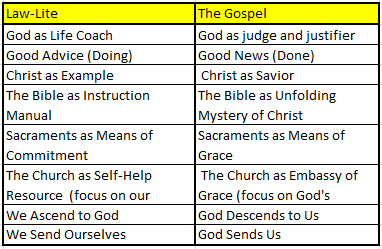
Michael Horton. Christless Christianity: The Alternative Gospel of the American Church (p. 196). Kindle Edition.
There is a huge difference between the two approaches. So the question for me becomes, is either one okay? Does God care if we land on one side, the other, or somewhere in the middle. Or maybe this is not a fair representation. I know that many who I consider to hold to the "Law Lite" position do not see themselves in that mold, and would argue that they do hold to the gospel.
Because these positions are so divergent, I don't think both can be acceptable. However, I do believe that God has some in each party, just as Satan has his minions on either side. That's just my opinion. I am not saying the theology is unimportant. I just happen to believe that a heart for God trumps bad theology. Jesus said the first and greatest commandment was to love God with all your heart, soul, and mind. I believe that if that is done with all sincerity, God will honor that love and provide a way.
Wednesday, November 20, 2013
Not everything is Gospel.

Michael Horton. Christless Christianity: The Alternative Gospel of the American Church (p. 109). Kindle Edition.
We need to be directed. I agree. But direction without destination is futile. Some focus on the direction, but lack the destination. Or some confuse the destination. I read a quote today, and it sounds so good. It was on a preacher's Facebook page.
"There is nothing God loves more than keeping promises, answering prayers, performing miracles, and fulfilling dreams. All he is waiting on...for us to ask. Dream big, PRAY big."*
I want to believe this. Trouble is, the Bible doesn't bear this out. David's son died. John the Baptist was beheaded. Jonah's shade was withered. Stephen was stoned. Paul was imprisoned. Jesus asked that the cup be taken from Him. I could go on. If God is all about fulfilling our dreams, didn't some of these men have a place at the front of the line?
There is nothing God loves more than His Son. Yet God allowed Him to suffer to keep His promise to Abram and to us. He has answered the prayers of the suffering, by giving them a vision that their suffering will not be eternal as they call out to Him. His greatest joy is to see that His Son's sacrifice was not in vain. That is the miracle of miracles. That is the fulfillment of the greatest dream ever, not to avoid the certainty of Hell, but to spend eternity in the presence of God.
I m not saying don't pray. Yes, pray your guts out. Like David, lay everything on the floor before God and leave nothing out. Share your pain and struggles, your frustrations and your joys. Expect miracles. Trust in Him completely. But remember the destination. The destination is eternity with God. It means that we love Him above all else and whatever we have to endure down here, we do faithfully.
*Upon doing some checking, I found that this quote is from a book by Mark Batterson.
Tuesday, November 19, 2013
Go down two blocks, then take a left.

Michael Horton. Christless Christianity: The Alternative Gospel of the American Church (p. 104). Kindle Edition.
I once asked a preacher why he was always telling people what to do or how to live. He replied that the Bible is full of such admonitions. And while that point is true, those admonitions are usually or maybe even always preceded by a gospel declaration, something that was not present in his preaching.
Michael hits pretty hard on Joel Osteen in his book in a few places, but rightfully so in my opinion. I guess it boils down to whether you believe the gospel is about your best life now or the best God of the universe. While I believe that God wants what is best for us, I don't believe it looks like what Mr. Osteen often promises.
Monday, November 18, 2013
Hurry up, company is coming!

"Paul regularly picks up on this theme. Familiar to suffering himself, Paul was always joyful not because of his circumstances but because of the gospel's promise that after we suffer for a little while we will share in Christ's resurrection glory."
Michael Horton. Christless Christianity: The Alternative Gospel of the American Church (pp. 95-96). Kindle Edition.
This whole Christianity thing would be so much better if it weren't for that bloody cross. At least that is what many think. It's like when you know company is coming over and you don't have much time to clean, so things start getting stuffed in places that they don't belong so we give the appearance of being neater than we really are.
We shouldn't have to clean up Christ to make him look better. If the God of the universe was willing to be naked on a cross, battered and bruised, then I think he can handle it if people know about that today.
Jesus said our burden is light. That is because he did all the hard stuff. He went to Calvary and endured God's wrath so that we wouldn't have to. If you take away the cross, then all that is left is us trying to be better so that we can earn God's favor. Are we really ready to take on the wrath of God ourselves? I'll take the cross instead.
Sunday, November 17, 2013
Not a damn thing.

Michael Horton. Christless Christianity: The Alternative Gospel of the American Church (pp. 73-74). Kindle Edition.
Our best efforts cannot satisfy God's Justice. Yet the good news is that God has satisfied his own justice and reconciled us to himself through the life, death, and resurrection of his Son. God's holy law can no longer condemn us because we are in Christ.
Michael Horton. Christless Christianity: The Alternative Gospel of the American Church (p. 91). Kindle Edition.
What do I hope to get by serving God? Not a damn thing that I don't already have. My righteous acts are but filthy rags before Him. I don't do it because of what I will get, I do it because of what I already got. (My apologies to those who are offended by my grammar.)
Friday, November 15, 2013
I did it all by myself!

Michael Horton. Christless Christianity: The Alternative Gospel of the American Church (pp. 62-63). Kindle Edition.
I use tools to make things. The tools can not assume any of the credit, for without me they are useless. God uses people to accomplish his plans, but the problems begin when we think we deserve some of the credit.
Churches boast about how they are growing as if they were doing something better than the church down the street, or as if their god were better than the others. Yet according to Scripture, it is God who causes growth, not man or even a well intentioned group of men. (My mind wanders to the Tower of Babel.)
It's not that growth is bad, but if growth were the true indicator, then we might as well sign up for Joel Osteen's church now.
So if God is in charge, why are we so distracted by all of these other things? Why are we promoting anything else? And perhaps most importantly, what are we trying to win people to?
Monday, November 11, 2013
Grab your bootstraps!

Michael Horton. Christless Christianity: The Alternative Gospel of the American Church (pp. 16-17). Kindle Edition.
So what do we do to combat this? I seriously struggle with this. It is difficult to listen to a speaker and rarely or never hear the name of Jesus. Does this bother anyone else?
Subscribe to:
Posts (Atom)